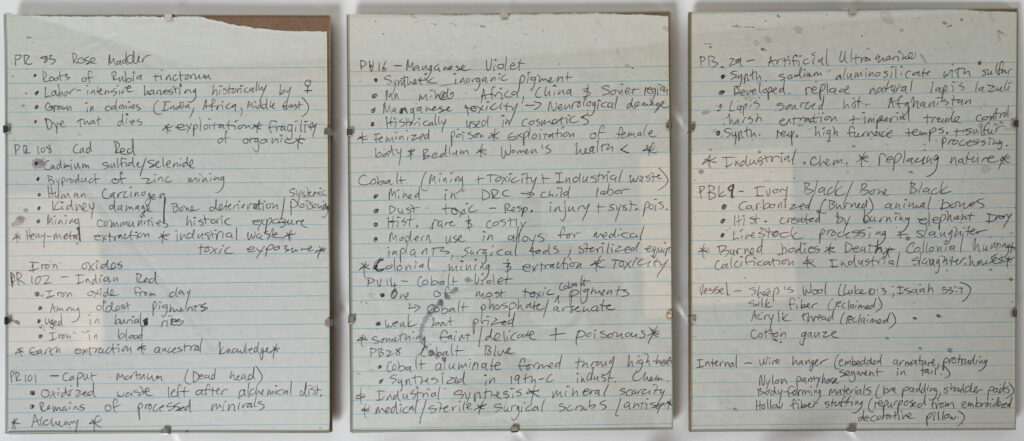
There are many ways artists use the choices they make to convey meaning.
The most obvious examples include:
Color – Zdzisław Beksiński uses Prussian Blue to paint nightmare versions of Holocaust scenes. The pigment carries a direct chemical association with the Holocaust: Prussian blue compounds formed as faint blue stains on some gas chamber walls when hydrogen cyanide from Zyklon B reacted with iron compounds in the masonry. Beksiński uses this pigment to invoke that history, making the color itself part of the work’s meaning.

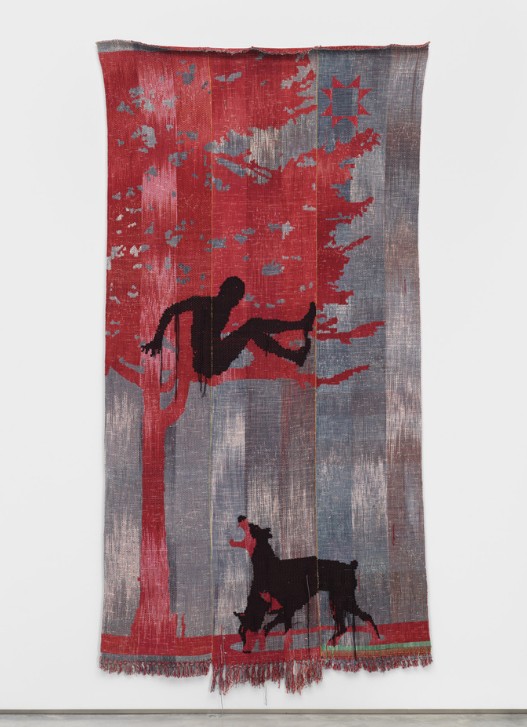
Subject – Diedrick Brackens creates tapestries featuring pitch-black, silhouetted human figures interwoven with wild animals. Brackens weaves large-scale tapestries using West African and American quilting traditions. He uses stark, black human silhouettes to universally symbolize the Black body, historical ghosts, and marginalized identities. The faceless shapes act as a universal proxy for collective memory, trauma, and resilience without needing to profile a specific historical person.
Technique – Noelle Mason
In her series Ground Control, Noelle Mason commissioned Mexican artisans to weave satellite images of the U.S.–Mexico border into handwoven wool tapestries. She paid the workshop the same amount it would have cost to smuggle a family of four across the border at that time. The financial exchange becomes part of the artwork itself, grounding abstract aerial surveillance in the economic and human realities of migration.
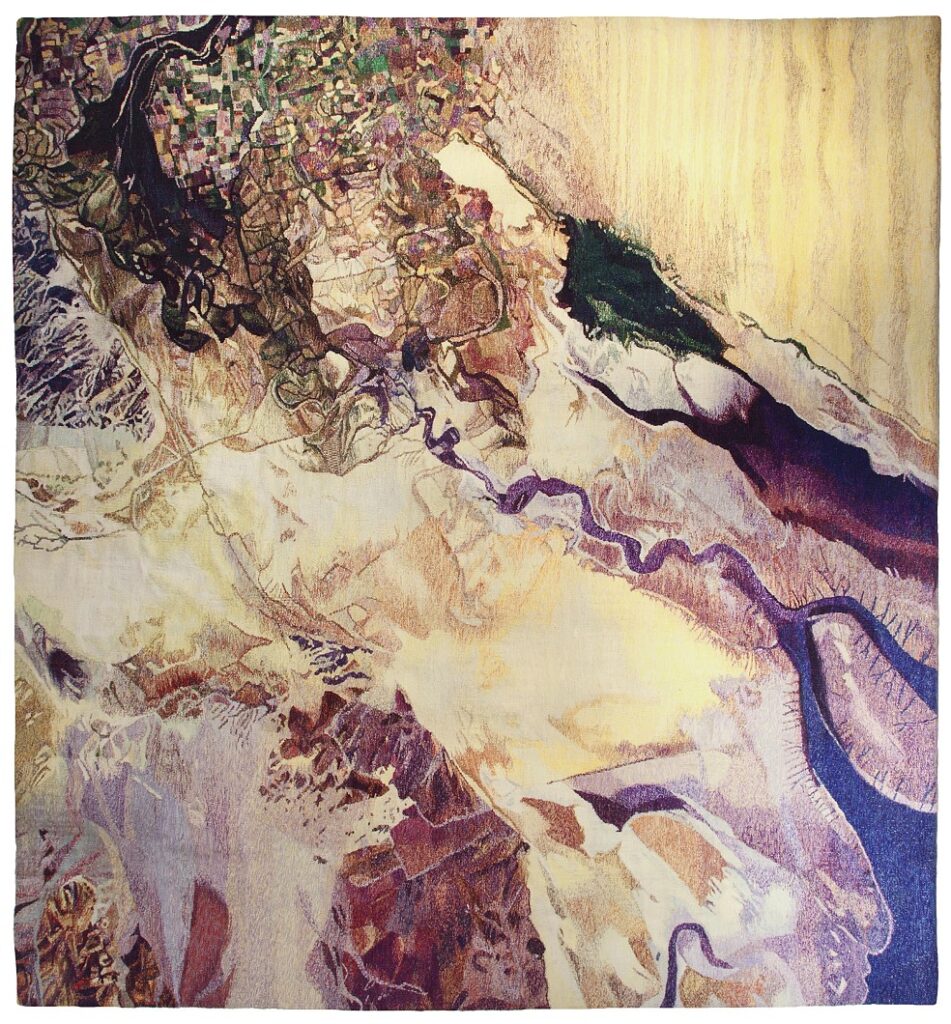
https://noellemason.com/artwork/1816861-Ground%20Control%20%28El%20Paso%2fCiudad%20Juarez%29.html
Art Materials
I want to focus on how I use materials to convey meaning. I am certainly not the first artist to do this.
El Anatsui weaves monumental shimmering forms from discarded liquor bottle caps joined with copper wire. The materials carry historical weight: alcohol was brought by European traders to West Africa as a commodity in the slave trade and later became intertwined with colonial extraction and industry. He transforms the debris of colonialism and consumer culture into luminous monuments that speak to resilience, interconnectedness, and history.
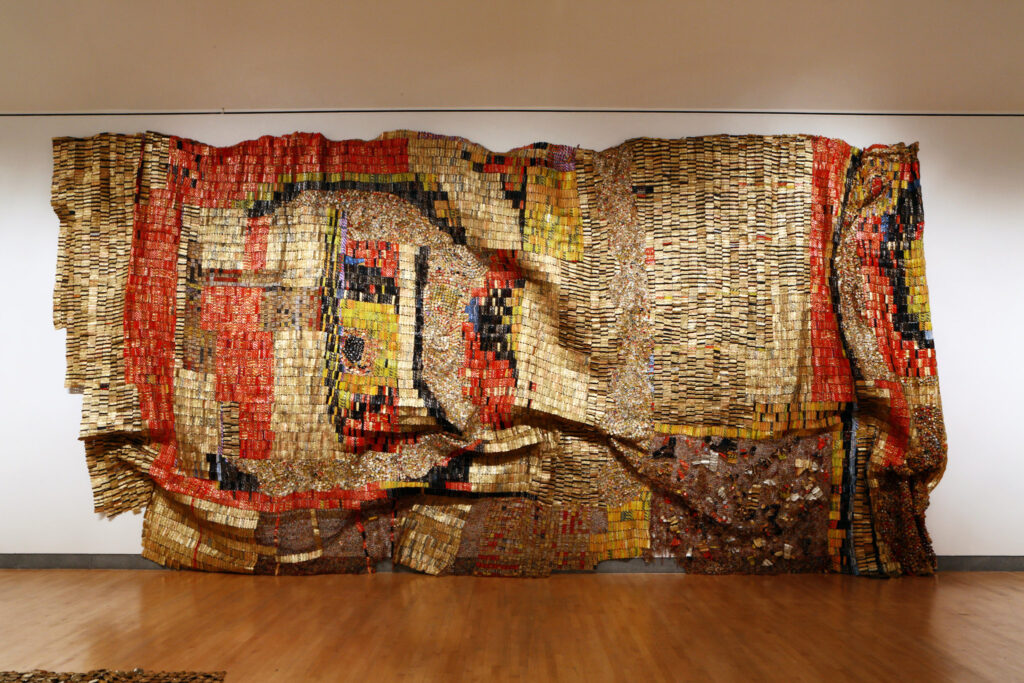
| What makes these works impossible to recreate with different materials? What if Noelle Mason had just printed a map on Spoonful? Or what if El Anatsui had ordered a sheet metal kit on Temu? |
What I learned from my background in Anthropology
In anthropology, we study the materials left behind by a society to understand its values and belief systems: the materials used in sacred places versus everyday life, the condition of objects when they were discarded, and what people chose to make art from.
There’s actually an academic term for this idea—materiality. Scholars in anthropology and archaeology have long argued that objects aren’t neutral; they carry social meaning.
Materiality:
This is the specific academic term for the argument that physical objects are not just passive, inert things. Instead, objects possess social agency. They actively embed, project, and sustain a civilization’s ideas, power dynamics, and values.
Cultural Materialism:
Coined by anthropologist Marvin Harris, this theory takes the idea a step further. It posits that a society’s “infrastructure” (its technology, economy, and physical environment) is the primary driver that actually dictates and molds its “superstructure” (values, religion, and ideology).
Cognitive Archaeology:
A sub-discipline of archaeology that uses the physical remains and material footprints of past societies to reconstruct their ancient thought processes, belief systems, and values.
| What will our art materials say about our values and search for meaning to the future archaeologists analyzing our work and our trash? |
In my own work, authenticity of materials is an important part of my message. I make material choices deliberately. For me, material authenticity means a material cannot simply simulate a visual texture—it must carry the physical memory or social history of the subject I am addressing.
Consider the materials used in the following work in progress:
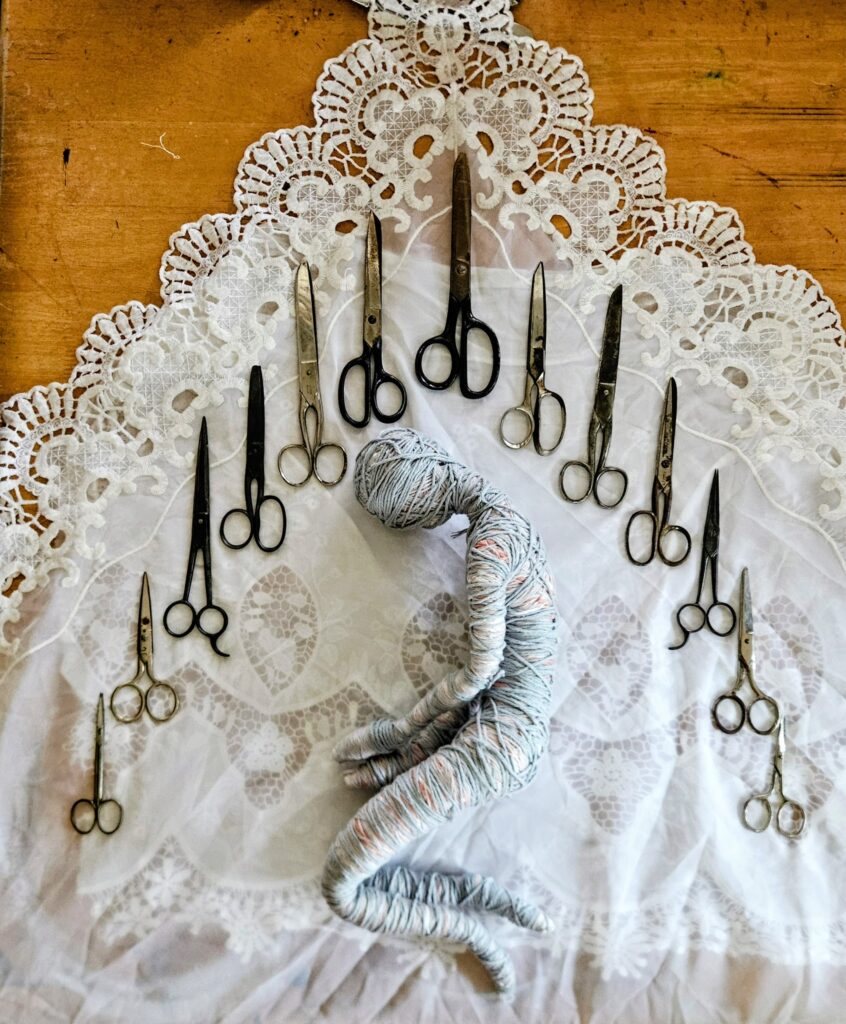
Which of the following two options is richer?
| Materials list A: | Materials list B: |
| Yarn Wire Stuffing Scissors Fabric | Salvaged and inherited yarn Bailing wire Dryer lint, shopping bags, body-shaping materials—bra pads and shoulder pads Vintage household sewing scissors Reclaimed domestic textiles |
I constructed her body from baling wire instead of armature wire.
I stuffed her with old clothing, shopping bags, and dryer lint instead of polyester fiberfill.
I shaped her with actual body-shaping materials—bra pads and shoulder pads.
The rope that binds her is also part of her, not something outside of her. Our ideas about femininity shape us. They influence how we behave, how we carry ourselves, how we alter our bodies, and what experiences we embody.
The thread comes from reclaimed domestic materials collected from older women who would say things like, “My daughters think learning to knit is old-fashioned.”
The piece becomes an examination of the changing meaning of femininity and its relationship to domestic and social space. How is women’s work being redefined? What is femininity constructed from? How do the expectations placed on women shape who we become?
Felted wool and stitching mirror the cycles of trauma and abuse. Wool is gently massaged into place and then gradually subjected to increasing pressure until it changes permanently, physically embodying gradual coercion and irreversible change.
Throughout the process I repeatedly tore apart and re-stitched the work, mirroring the recurring cycles of complex trauma.
Wool also carries cultural meaning for me. It recalls sheep, the lamb, meekness, and my own upbringing on a farm where I remember shearing day. That cultural environment helped shape beliefs about women being meek and compliant. The materials become clues to the themes I am exploring.
Across my practice, I have established a few permanent rules: everything is ethically sourced, as much as possible is reclaimed or secondhand, and no material is used without a compelling conceptual reason.
If I showed you this and told you I had ordered new rope and imitation fishing net online, what would you be able to discern about the meaning?
If I told you instead that I had sourced genuine discarded marine rope left behind with an abandoned crab trap, collected beach debris—ghost fishing gear, abandoned hooks, nylon rope, and nets that continue trapping and killing wildlife, what does this tell you? In this context, what does the title mean?
The piece would lose much of its meaning if I had used generic materials. By sourcing my supplies by collecting actual beach trash I learned from the experience.
I found it surprisingly difficult to distinguish sea-grass from plastic bags, even knowing exactly what I was looking for. I saw trash entangling small animals and plastic wrapped around young mangroves, trapping the very species that depend on them as nursery habitat. Those observations changed both the direction and the meaning of the work.
| Closing question: What do your materials communicate about your intentions? |
FACD
If today’s discussion resonates with you—if you’ve found yourself thinking about what your materials communicate, or how your work can carry meaning beyond its surface—you might enjoy our newest small interest group Fiber Artists Contemporary Discourse (FACD). We’re a group of artists interested in contemporary fiber practice, critical inquiry, experimentation, and thoughtful conversation about the ideas that drive our work.
Fiber Artists Contemporary Discourse (FACD) is an interest group for artists working with fiber and textile-based materials who engage with contemporary ideas, critical inquiry, and experimental practice.
This group welcomes artists whose work extends beyond technique to explore questions of meaning, materiality, identity, culture, memory, politics, the body, the environment, and other issues shaping contemporary life. Members are encouraged to investigate conceptual approaches, push techniques in new directions, make intentional material choices, and engage in thoughtful discussion about the ideas driving their work.
FACD is a space for fiber artists, soft sculptors, installation artists, experimental makers, interdisciplinary artists, and other creative practitioners interested in pushing boundaries and expanding what fiber-based art can be. While fiber is our primary focus, artists working across media are welcome if critical engagement and contemporary discourse are central to their practice.
Meetings may include making meet-ups, artist talks, critique sessions, discussions of exhibitions and readings, works-in-progress, and conversations about opportunities, materials, process, and ethics in artistic practice.
FACD is for artists who are curious, questioning, inventive, and willing to engage with complexity. Whether your work is subtle or confrontational, personal or political, abstract or representational, this group is a place to explore ideas, exchange perspectives, and connect with others who want to go beyond the surface and engage deeply with ideas.
Questions for Reflection:
What assumptions do your materials carry?
What can viewers learn from your materials lists?
What histories are embedded in the things you use?
If your work were remade with different materials, would it still mean the same thing?
Are your material choices reinforcing your concept?
What would a future archaeologist infer about your values from your artwork alone?
Leave a Reply